


Why Colorado Is Different for Heat Pumps
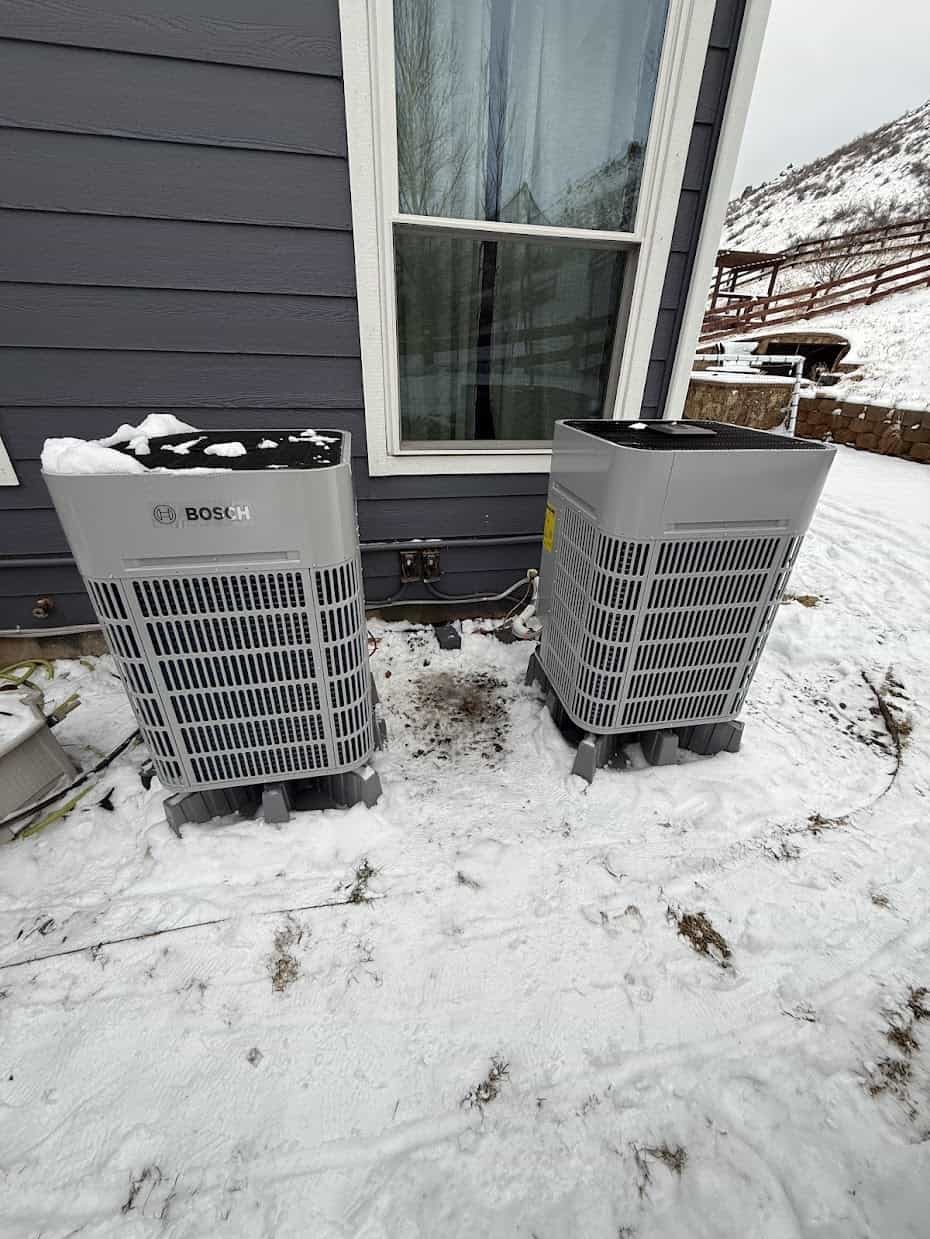
Most heat pump guides are written for sea-level climates. Colorado isn’t that. Between altitude, climate zones, and dry air, the rules shift in ways that generic advice misses.
Altitude affects compressor performance. Denver sits at 5,280 ft. Air is roughly 17% less dense than at sea level. That matters because air-source heat pumps extract heat from outdoor air - less air density means less heat available per cubic foot. Compressors work harder to move the same BTUs, defrost cycles run slightly more often at altitude, and manufacturer capacity ratings (tested at sea level) don’t translate 1:1. Across 12,000+ installations on the Front Range, real-world capacity at altitude runs 5-10% below published specs. Proper sizing accounts for this. Many installers don’t.
Colorado has three distinct climate zones, and each demands different equipment choices.
| Zone | Design Temp | Backup Heat | Details |
|---|---|---|---|
| Front Range (Denver, Boulder, Fort Collins, Colorado Springs) | -5 to -10°F | Optional but common | |
| Mountain Towns (Breckenridge, Vail, Leadville) | -20°F or lower | Required | |
| Eastern Plains (Limon, Burlington, La Junta) | -10°F | Recommended |
Dry air is an advantage. Unlike the Midwest or Northeast, Colorado’s low humidity means less frost buildup on outdoor coils. Fewer defrost cycles means more time heating. It’s one reason heat pumps often outperform their specs here relative to the temperature range.
What our installation data shows. During the December 2022 polar vortex (-15°F), properly sized cold climate heat pump systems held homes at 68-69°F without backup heat activating. But “properly sized” and “cold-climate rated” are doing a lot of work in that sentence. Get either one wrong and you’ll be disappointed.
For the deep dives on specific topics:
Which Heat Pump System Fits Your Colorado Home?
The right system depends less on brand preference and more on what your house actually is. Colorado’s housing stock ranges from 1890s Victorians to 2020s production builds, and the best heat pump configuration for each is different.
Ranch or bi-level with ductwork
→Ducted heat pump
Replaces your furnace and AC with one unit. Lowest disruption, hidden equipment, whole-home coverage.
Older home without ducts
→Ductless mini-splits
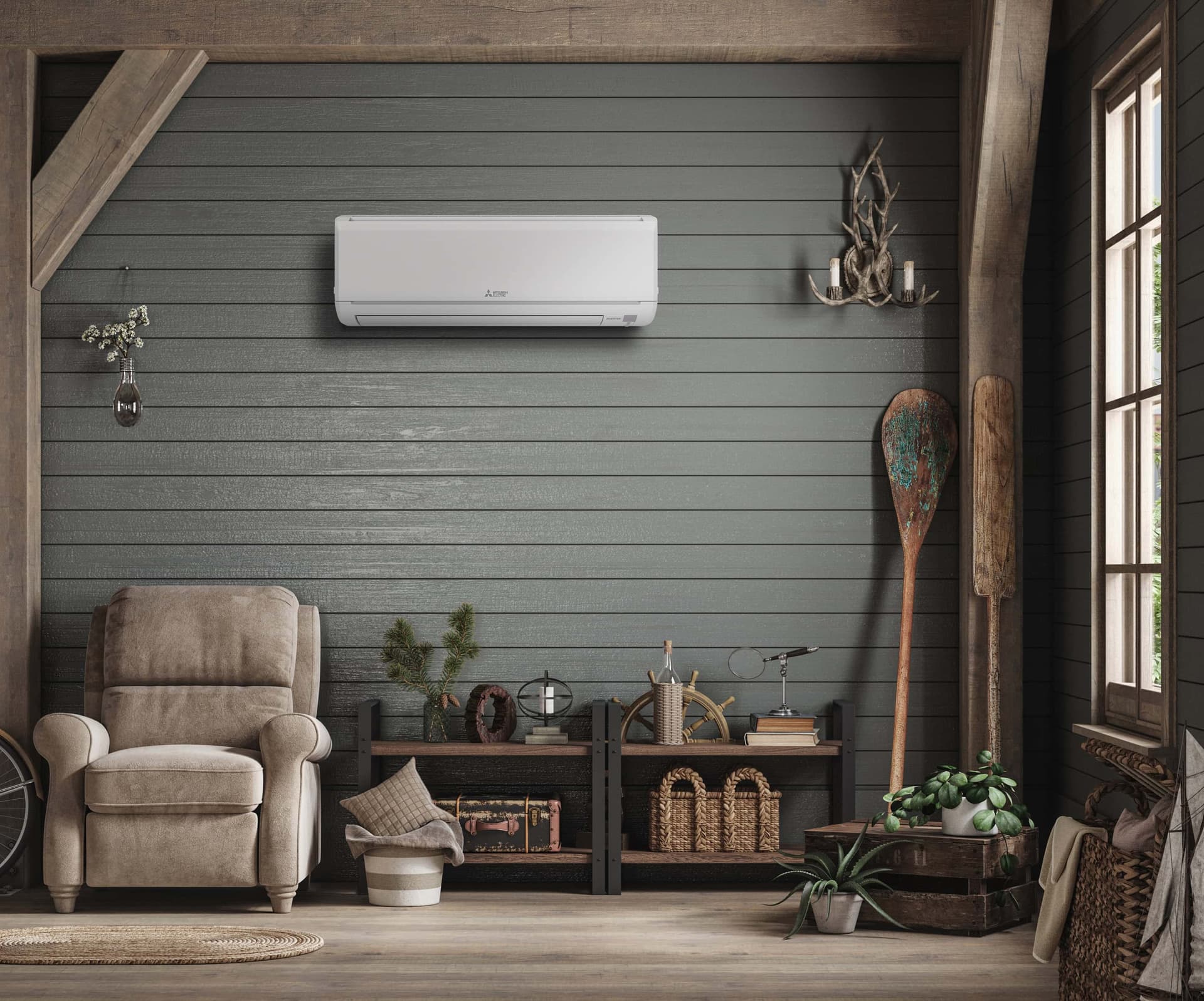
Wall-mounted heads per zone, no invasive ductwork. Adds cooling while converting heating to electric. Ideal for Victorians, bungalows, and radiant heat homes.
New construction
→Either works
Ducted is typical since builders include ductwork. Spec the heat pump during design to avoid retrofitting later.
Addition, garage, or basement
→Ductless single-zone
Extending existing ducts is expensive and often undersized. A dedicated mini-split handles its own load independently.
Colorado is a heating-dominant climate. This shifts priorities. Most of the country shops for AC first and treats heating as a bonus. Here, your heat pump runs in heating mode 6+ months of the year. Heating capacity at 5°F matters more than cooling SEER. An 18 SEER2 unit with 10 HSPF2 is a better Colorado buy than a 21 SEER2 unit with 8.5 HSPF2 - even though the second one looks better on paper for cooling.
Ducted vs. ductless: a direct comparison.
| Factor | Ducted Heat Pump | Ductless Mini-Split | Details |
|---|---|---|---|
| Best for | Homes with existing ductwork | Homes without ducts, additions, zones | |
| Equipment visibility | Hidden in mechanical room | Wall units visible in each room | |
| Installation disruption | Low (1-2 days) | Low to moderate (per zone) | |
| Zoning control | Whole-home or basic zones | Individual room control | |
| Typical installed cost | $12,000-$20,000 | $4,000-$8,000 per zone | |
| Xcel rebate eligible | Yes | Yes |
Dual fuel provides operating cost flexibility. Natural gas here runs about $1.10/therm through Xcel. Below roughly 20°F, gas often costs less per BTU than electricity. A dual fuel system (heat pump + gas furnace) can switch to whichever fuel is cheaper. The outdoor unit is the same cold-climate heat pump you’d get with all-electric; the furnace just adds the option to use gas when rates favor it. Fully electric works fine. Dual fuel lets you adapt as energy prices shift.
Dual Fuel vs. Fully Electric: Quick Comparison
Dual Fuel
- Lower operating cost when gas is cheap
- Heat pump handles mild weather efficiently
- Gas furnace covers deep cold
- Two systems to maintain
- Requires existing gas line
Fully Electric
- One system, simpler maintenance
- No gas line required
- Full rebate eligibility (HEAR, Xcel)
- Higher operating cost at deep cold
- May need panel upgrade
For the detailed comparisons:
Preparing Your Home

Four things to evaluate before signing a contract. Each one can affect your final cost and which rebates you qualify for.
1. Electrical panel capacity. A whole-home ducted heat pump draws 30-50 amps at 240V. Most homes with a 200A panel have headroom. Homes with 100A panels often don’t, and an upgrade adds $2,000-$4,000. We assess panel capacity at every site visit - it’s not something to guess. UniColorado installs 200A upgrades as standard; 320A is available for whole-home electrification projects (multiple large loads). There is no 400A residential service available.
2. Ductwork condition. Heat pumps move air at lower supply temperatures than gas furnaces (95-105°F vs 120-140°F), which means they need adequate airflow to deliver the same comfort. Leaky or undersized ducts that “worked” with a gas furnace may not work as well with a heat pump. A duct leakage test ($150-$300) tells you what you’re working with. Most Front Range homes built after 1990 pass without modifications.
3. Building envelope. Heat pumps are efficient, but insulation determines how much heating load they have to cover. Adding attic insulation before sizing can mean a smaller (cheaper) system. We often recommend a blower door test for older homes - it identifies where the heat is escaping before we spec the equipment.
4. Contractor selection. The heat pump itself matters less than the installation quality. A well-installed mid-tier unit outperforms a poorly installed premium one. Warning signs: no Manual J load calculation (rules-of-thumb sizing is unreliable at altitude), no mention of refrigerant line sizing, no discussion of backup heat strategy.
HVAC quote transparency checklist
- Manual J load calculation (not rules of thumb)
- Itemized equipment model numbers and HSPF2 ratings
- Electrical work scope and permit status
- Rebate application handling (who files, what's needed)
- Backup heat strategy and sizing
- Ductwork assessment or leakage test results
2026 Colorado Heat Pump Rebates
Federal 25C ended December 2025. Denver CARe ended 2025. But the remaining programs are substantial - and stackable. Over $2,000,000 in rebates secured for Colorado homeowners.
| Program | Max Rebate | Income Req. | Stackable | Status |
|---|---|---|---|---|
Xcel Energy (cold climate) Per heating ton at 5°F | $2,250/ton | Any Income | Stackable | Active |
Xcel Energy (standard ASHP) Per cooling ton at 95°F | $900/ton | Any Income | Stackable | Active |
HEAR (80-150% AMI) Up to 50% of project cost | $8,000 | Income-Based | Stackable | Active |
HEAR (<80% AMI) Up to 100% of project cost | $8,000 | Income-Based | Stackable | Active |
| $1,000 | Any Income | Stackable | Active | |
United Power Ducted >2 ton. Brighton, Erie, Firestone area. | $1,000 | Any Income | Stackable | Active |
Longmont / Efficiency Works Per unit + $2,000 bundling bonus | $2,000 | Any Income | Stackable | Active |
EnergySmart (Boulder County) 70% of project cost cap | Varies | Any Income | Stackable | Active |
Power Ahead (DRCOG) Cold climate certified. Does NOT stack with HEAR (both federally funded). | $1,500 | Any Income | Stackable | April 2026 |
| - | - | - | Ended May 2025 | |
| - | - | - | Ended Dec 2025 |
Xcel Energy Rebates (ACTIVE). $2,250/ton for cold-climate heat pumps, no income limit. A 3-ton system qualifies for $6,750; a 4-ton for $9,000. Xcel processes the rebate after installation - we handle the paperwork. See the Xcel Energy rebates page for eligibility and current amounts.
HEAR Program (ACTIVE). Up to $8,000, income-qualified at up to 150% of Area Median Income. For a family of 4 in Denver, 150% AMI is roughly $142,000/year. This stacks with Xcel rebates. See our Colorado HEAR rebates guide for eligibility and application details.
Colorado State Tax Credit (ACTIVE). $1,000 credit on your Colorado state return for qualifying heat pump installations. No income limit. Claimed on Form DR 1307.
Stacking example. A qualifying household installing a 3-ton cold-climate heat pump could access: Xcel $6,750 + HEAR $8,000 + Colorado $1,000 = $15,750 in incentives against a typical $14,000-$18,000 install cost. Net out-of-pocket can be near zero for income-qualifying households.
Why Denver Homeowners Choose UniColorado for Heat Pumps
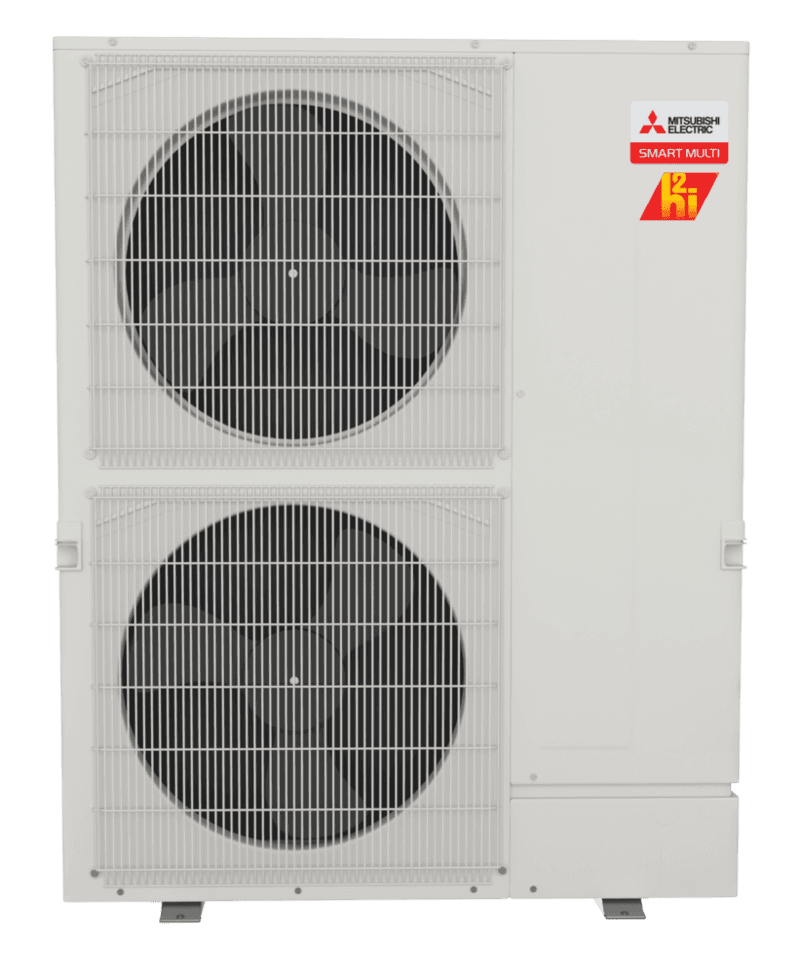
Over 12,000 heat pump installations across the Denver metro and Front Range. That includes ducted systems, ductless mini-splits, dual-fuel configurations, and full home electrification projects. We install Mitsubishi, Bosch, and Carrier, and we choose based on what the home needs, not what has the highest margin.
Every system gets a Manual J load calculation. At 5,280 ft, published capacity ratings don’t translate 1:1 from sea level. We account for altitude, your home’s actual insulation, window orientation, and duct condition. Proper sizing means the right comfort, the right efficiency, and the highest rebate tier.
We handle all rebate paperwork. Xcel Energy, HEAR, Colorado state tax credit, EnergySmart, United Power, Efficiency Works. We apply every qualifying program as an upfront discount on your invoice. You don’t file anything.
Registered for every active rebate program in Colorado. As a certified Xcel Energy Trade Ally, registered HEAR contractor, and Colorado Department of Revenue registered installer, we process the paperwork for programs that many contractors don’t participate in.
Ready to Talk About Your Home?
We’ll evaluate your home, run load calculations, confirm your rebate eligibility, and show you exactly what a heat pump system costs - before you commit to anything.


Get a Free Heat Pump Assessment
We'll confirm your rebate eligibility, assess your panel and ductwork, and give you real numbers - not ballpark ranges.