













Off the top vs. pay and chase
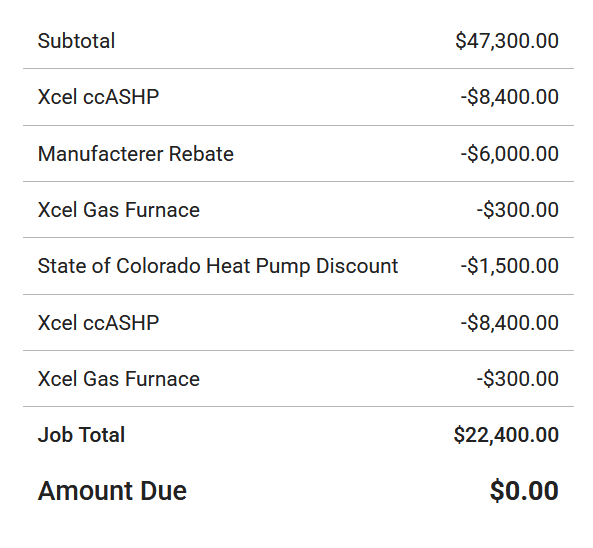
Off the top: the contractor deducts the rebates from your invoice, files every application, and gets reimbursed later. You pay or finance only the net amount. This is how we operate: a $23,000 system with $7,000 in stacked incentives means the contract says $16,000.
Pay and chase: you pay the full gross price and the contractor "helps with paperwork" while you wait for checks. The quote says "eligible for up to $X." If the application stalls or the math comes out lower, the gap is yours.
The amounts are the same either way. What changes is who floats the cash and who carries the risk, and on a typical Denver heat pump that float is $8,000-$10,000.
The state credit: your contractor can keep two-thirds
Since 2024, the homeowner does not claim the Colorado heat pump credit at all. The contractor claims it on their own taxes, and state rules let them keep up to two-thirds. Only one-third has to reach you, as a line reading "State of Colorado Heat Pump Discount" on the invoice. Callers regularly don't believe this the first time, but it's how the program was built: the retention is the state's carrot for contractors to register at all. Some pass the minimum. We pass the full advertised discount, on its own invoice line, so you can verify it in ten seconds.
Two more rules: the credit only exists through registered contractors (DIY installs get nothing), and the discount is once per address, ever. If a previous owner used it on your house, it's spent.
Xcel rebates: the alternate recipient form
Xcel's rebates are the biggest dollars in the stack and they scale per ton: $1,500 per heating ton for cold climate equipment, so a 3-ton system is $4,500 and a 4-ton is $6,000. If a quote's rebate number doesn't divide by the tonnage, ask why.
By default Xcel mails the check to the account holder weeks after processing. The alternate-recipient form redirects it to the contractor instead, which is what makes the upfront discount possible: the check goes to us because the discount already went to you. Routine paperwork, but check the invoice math before signing. Two things decide eligibility: the application carries the Xcel account holder's name (watch this on rentals), and your service must actually be Xcel. Xcel lowered its bonus on October 1, 2026; our October rebate change guide has the before and after amounts.
Power Ahead: filed for you
Power Ahead Colorado is the simplest: a flat $1,500 for a qualifying cold climate heat pump in the Denver metro, no income limit, no homeowner application. The contractor files it and the amount comes off your invoice. If a contractor asks you to apply, something is wrong; homeowners can't.
One correction we keep making on the phone: we are not the program, and neither is any other contractor. It's DRCOG's money; contractors deliver it. Same for the state credit and Xcel. And the federal 25C credit, the one thing you used to file yourself, ended December 2025. In 2026 every remaining incentive is contractor-filed; your whole job is reading the invoice.
What if a rebate is rejected?
The sharpest question you can ask a contractor: "If the program rejects the application, do you come after me for the money?" Our answer: no. If we qualified the job and quoted the rebate, a rejection is our cost and your contract price stands. We can carry that because we qualify before quoting: AHRI listing, tonnage math, utility accounts, program status, all checked on estimate day.
"You're eligible for up to $7,500 and we'll help with paperwork" puts that risk on you instead. Eligibility pays nothing by itself, and "help" is not a guarantee.
What to check on any quote
- Check
- Are rebates deducted on the contract?
- What good looks like
- Net price on the signature line, each incentive itemized. Not "eligible for up to."
- Check
- Is the state discount its own line?
- What good looks like
- A line reading "State of Colorado Heat Pump Discount" - required by state rules.
- Check
- Does the Xcel math check out?
- What good looks like
- Cold climate rebate = $1,500 x heating tons (since Oct 1, 2026).
- Check
- Who absorbs a rejection?
- What good looks like
- In writing: the quoted net price stands if a qualified application is denied.

Want a quote with the rebates already off the top?
We file everything: Xcel, the state discount, Power Ahead. The price on your contract is the price after all of it.