


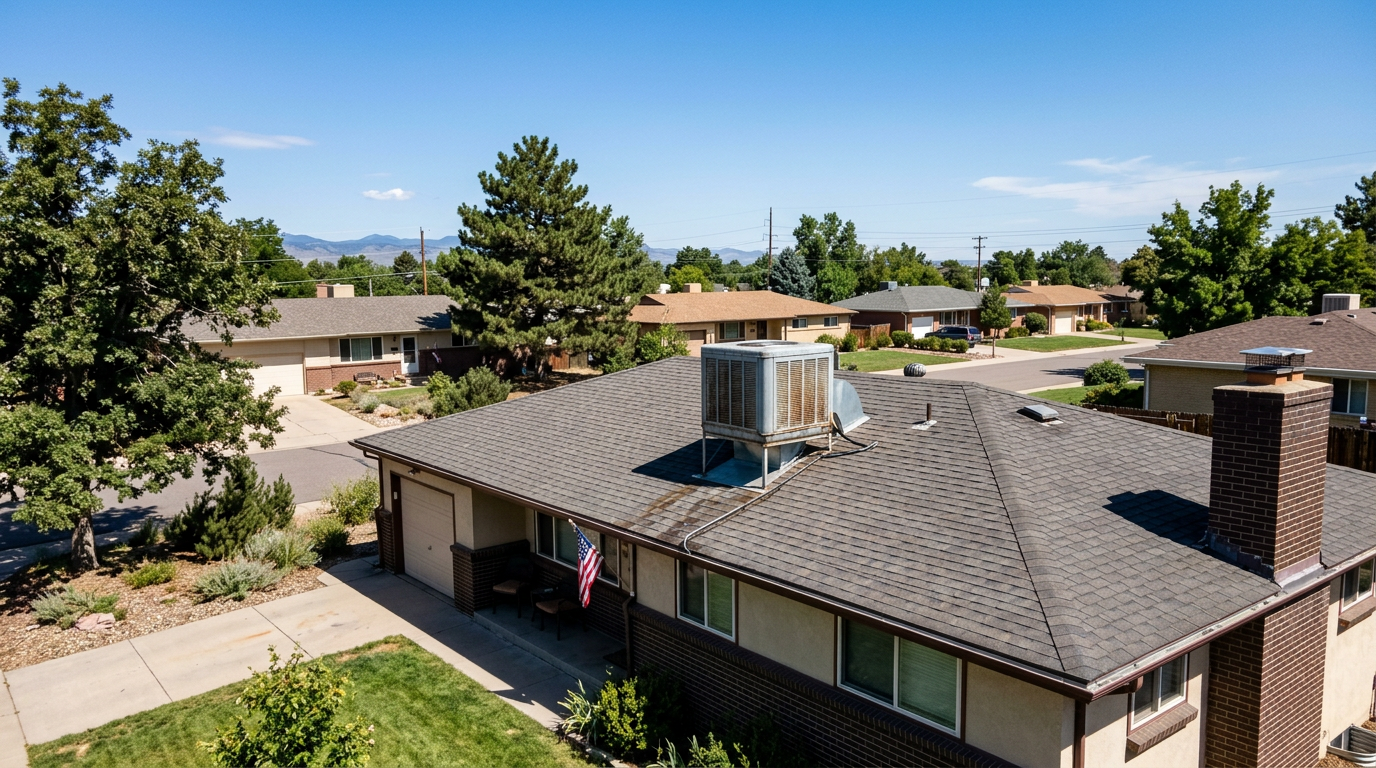
If you grew up in Denver, you probably grew up with a swamp cooler. They worked great when summers meant a few hot days in July and you could leave windows open all season.
That is not Denver anymore.
Denver's summers have changed
The data is clear:
- Denver is 2.6°F warmer than it was in 1970
- Days hitting 95°F: used to average 5 per year, now 20+
- Days hitting 90°F: average was 30 days; in 2020 Denver hit 75 days
- 11 of the hottest years on record have all occurred since 1994
And it is not just hotter - it is hotter for longer stretches. Multi-day heat waves that would have been rare in the 1990s are now routine.
Why swamp coolers are struggling
Swamp coolers (evaporative coolers) work by evaporating water to cool air. This only works when the air is dry enough to absorb moisture.
| Humidity | Temperature Drop | Comfort Level |
|---|---|---|
| 20% | 25-30°F | Excellent |
| 40% | 15-20°F | Good |
| 50% | 10°F | Marginal |
| 60%+ | 5°F or less | Ineffective |
Denver's summer humidity averages 44-50%, with monsoon afternoons pushing into the 50-60% range. When relative humidity climbs above 50%, your evaporative cooler's effectiveness drops dramatically. Your swamp cooler works great on dry June mornings. By mid-July, during the hottest part of the day when you need it most, it is barely making a difference.
The smoke problem
Swamp coolers require open windows. That is how they work - they push air through, and it has to go somewhere.
During wildfire smoke season (increasingly June through September), opening windows means filling your home with hazardous air. In July 2024, Denver recorded particulate matter seven times higher than EPA safe levels. Multiple days hit "unhealthy" or "hazardous" ratings.
You can run your swamp cooler and breathe smoke, or close the windows and sweat. Neither is acceptable.
Your real options based on what you have
Your cooling options depend on what heating system you currently have.
If you have a swamp cooler + furnace
Important: Swamp cooler ductwork is not compatible with central AC or heat pump systems. The ducts are different sizes, in different locations, and designed for completely different airflow patterns. Swamp coolers move 4,500-6,500 CFM of air, while a typical AC system moves around 1,600 CFM. You cannot simply "convert" swamp cooler ducts to AC ducts.
Your options:
- Add new ductwork for central AC or heat pump - significant construction and cost
- Install a mini-split system - no ductwork needed, often the most practical choice
- Keep the swamp cooler for mild dry days, add a mini-split for hot or smoky days
If you have a boiler (radiator heat)
Boiler homes have no ductwork at all. Your only realistic option for whole-home cooling is a mini-split system. The upside: mini-splits are highly efficient and give you room-by-room temperature control.
If you have a furnace with existing ductwork
You have the most flexibility:
- Central AC - uses your existing ducts, cooling only
- Ducted heat pump - uses your existing ducts, provides both heating and cooling; can work alongside your furnace (dual-fuel) or replace it entirely
Cost comparison: ducted systems

For homes with existing ductwork, here is what cooling options actually cost (after Xcel and state rebates, not including HEAR):
| System | After Standard Rebates | Handles Smoke |
|---|---|---|
| Central AC only | $6,000-$10,000 | Yes |
| Ducted heat pump (Carrier) | $11,000-$13,000 | Yes |
| Ducted heat pump (Bosch) | $12,000-$14,000 | Yes |
| Ducted heat pump (Mitsubishi) | $14,000-$15,500 | Yes |
Note: Central AC does not qualify for heat pump rebates. A ducted heat pump often costs similar to AC after incentives - and you get efficient heating as a bonus.
For HEAR-eligible households, heat pump costs drop another $4,000-$8,000, making them significantly less than AC-only options.
The smoke-season factor

This is the deciding factor for many Denver homeowners.
If you work from home, have kids, have respiratory issues, or simply do not want to breathe hazardous air for weeks each summer, closed-system cooling has become a necessity in Denver.
What we recommend
- If you have existing ductwork: A ducted heat pump is usually the best long-term value. With current rebates, it is often cheaper than central AC, and you get efficient heating as a bonus.
- If you have a boiler or swamp-cooler-only home: A mini-split system is your most practical path to real cooling. No major construction, high efficiency, excellent comfort.
- If you are on a tight budget: A single-zone mini-split in your main living area can make your home livable during heat waves and smoke events, even if it does not cool every room.
- Do not do: Spend $1,500-$3,500 on a new swamp cooler expecting it to handle modern Denver summers. The underlying humidity and smoke problems will not go away.
Contact UniColorado for a free evaluation of your home and options. We will tell you exactly what is possible given your current setup - and what it will actually cost after rebates.