
TL;DR
Key Facts
- The 25C heat pump tax credit ended December 31, 2025
- The 30% residential solar tax credit (25D) ended December 31, 2025
- If you completed an installation in 2025, you can still claim the credit on your 2025 tax return
- State and utility rebates (Xcel, HEAR, DRCOG) are not affected
In July 2025, a new federal law nicknamed the "Big Beautiful Bill" was signed into effect, bringing big changes to home energy incentives. Officially called the One Big Beautiful Bill Act (OBBBA), this ends key federal tax credits for residential HVAC upgrades and solar installations at the end of 2025.
These credits have now expired. Below we break down what changed and how it impacts homeowners looking to install a heat pump or solar panels going forward.

End of Federal HVAC Tax Credit (Section 25C)
The Residential Energy Efficient Home Improvement Tax Credit (Section 25C) - which many homeowners used for HVAC improvements like heat pumps, efficient furnaces, insulation, and windows - was sunset earlier than expected.
This credit covered 30% of the cost of qualifying home upgrades (with caps up to $3,200 per year). Under the Inflation Reduction Act (IRA) of 2022, 25C was originally available through 2032. The new bill cuts that timeline: any improvements placed in service after December 31, 2025 won't qualify for the federal 25C credit.
The 25C Federal tax credit, most commonly used for heat pumps and heat pump water heaters, is gone after 2025.
End of 30% Residential Solar Tax Credit (Section 25D)
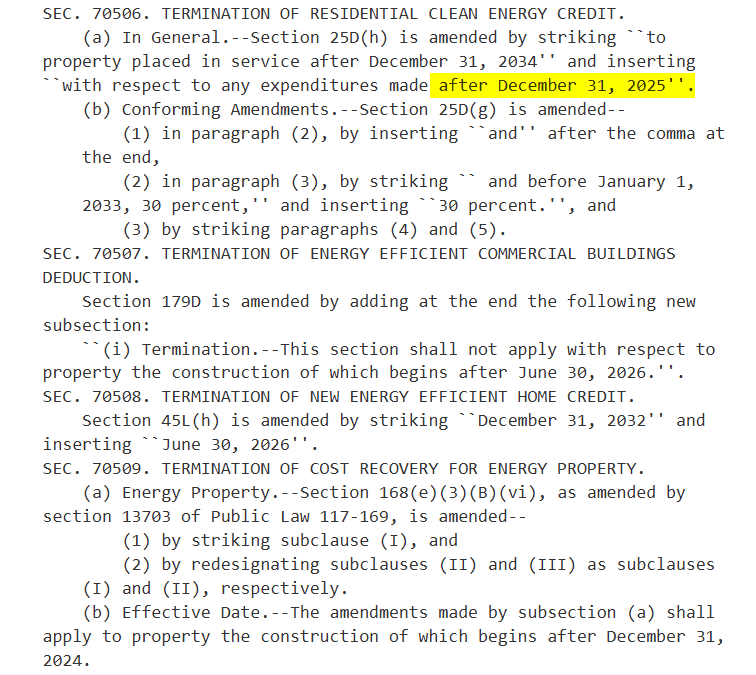
Home solar incentives saw a similar rollback. The Residential Clean Energy Credit (Section 25D) - the 30% federal solar tax credit for installing solar panels, home batteries, solar water heaters, and similar systems - expired at the end of 2025, much earlier than planned. This credit has been a cornerstone of solar affordability, giving homeowners a dollar-for-dollar tax reduction equal to 30% of their solar installation cost. Under previous law (the IRA), the 30% solar credit was set to continue into the 2030s. The Big Beautiful Bill accelerated its end by nearly a decade. Systems installed after December 31, 2025 receive no federal solar tax credit.
The 25D Federal tax credit for residential solar is gone after 2025.

Before vs. After: Tax Credit Timeline Comparison
- Credit
- 25C Heat Pump/HVAC
- Original End Date (IRA)
- December 31, 2032
- Actual End Date (OBBBA)
- December 31, 2025
- Max Credit
- $2,000
- Credit
- 25C Panel Upgrade
- Original End Date (IRA)
- December 31, 2032
- Actual End Date (OBBBA)
- December 31, 2025
- Max Credit
- $600
- Credit
- 25D Residential Solar
- Original End Date (IRA)
- Stepped down after 2032
- Actual End Date (OBBBA)
- December 31, 2025
- Max Credit
- 30% uncapped
- Credit
- 30C EV Charger
- Original End Date (IRA)
- December 31, 2032
- Actual End Date (OBBBA)
- Still active (check IRS)
- Max Credit
- $1,000
Both credits created or expanded by the IRA ended on an identical schedule: no new residential credits after December 31, 2025 for solar or efficient HVAC upgrades. Homeowners who completed installations in 2025 can still claim these credits when filing their 2025 taxes.
Installations completed in 2026 or later do not qualify for these federal credits, barring new legislation.
What This Means for Homeowners
Higher upfront costs: Without federal tax credits, the cost of home energy upgrades has increased. A $30,000 solar system that previously cost about $21,000 after the 30% credit now costs the full $30,000. A $10,000 heat pump no longer benefits from the $2,000 credit.
Longer payback period: Removing the credits means a longer time to recoup the cost of solar and efficient HVAC systems. Utility savings still help, but the early boost from federal incentives is gone.
The deadline has passed: The federal credits expired December 31, 2025. Homeowners who completed installations in 2025 can still claim the credits on their 2025 tax returns. New installations in 2026 do not qualify.
Alternative incentives remain: State, city, and utility rebate programs are not affected by the federal changes. Xcel Energy rebates and Colorado HEAR rebates continue. DRCOG rebates launched in January 2026.
Bottom line: Federal tax credits ended after 2025. Going forward, the decision to upgrade depends on state and utility incentives, HEAR rebates for income-qualified households, and long-term energy savings.
What's Still Available in 2026
Federal credits ended, but Colorado incentives continue
- Xcel Energy HVAC rebates - increased in 2024, still active
- Colorado HEAR rebates - up to $8,000 for income-qualified households
- DRCOG rebates - launched January 2026 for metro Denver area
- State of Colorado heat pump tax credit - check current year status
Colorado's most experienced heat pump installer
While the federal tax credits have ended, state and utility rebates remain available. UniColorado has been designing and installing heat pump systems in Colorado for over a decade. Unlike many contractors who place rebate risks and waiting periods on homeowners, we immediately apply your Xcel rebate as an upfront discount, saving you money from day one.


Xcel Rebates Applied Upfront
We deduct your Xcel rebate directly from the invoice. No waiting, no paperwork.
Related Guides
What the January 2025 executive order meant for Colorado homeowners
Income-qualified rebates up to $8,000 - active and accepting applications
Xcel's $440M electrification program and expanded rebates
Claim the credit for qualifying 2025 installations